4 min read
The Hybrid Mismatch: Why Flexible Work Policies Are Racing Ahead of Space Standards
Veena Vadgama
:
Jan 28, 2026 10:34:30 AM
by Veena Vadgama, CMO at CampusIQ
When CampusIQ partnered with Huron to launch the 2026 State of Space Management Survey, we had a hypothesis: higher education's relationship with physical space was changing in fundamental ways. What we didn't fully anticipate was just how wide the gap had grown between HR policy and facilities reality.
The results are in, and they tell a story that every facilities leader, provost, and campus planner needs to hear.
We surveyed 31 universities across North America—institutions managing millions of square feet, operating multiple campuses, and navigating some of the most complex space portfolios in the sector. What emerged was a striking disconnect: while 90% of institutions have embraced flexible work policies, only 26% have actually connected those policies to how office space gets assigned. Nearly half haven't updated their space standards since 2021.
This week, our CEO Aaron Benz sat down with Andrew Sama, Higher Education Director at Huron, to unpack one of the survey's most critical findings: the Hybrid Mismatch.
The Policy Gap That's Costing Millions
Here's what the data reveals about space planning in higher education today:
- 90% have flexible remote work policies in place—hybrid work is no longer an experiment, it's embedded in HR policy across the sector.
- Only 26% link those policies to office assignments—meaning work patterns have changed, but the physical space rules remain frozen in time.
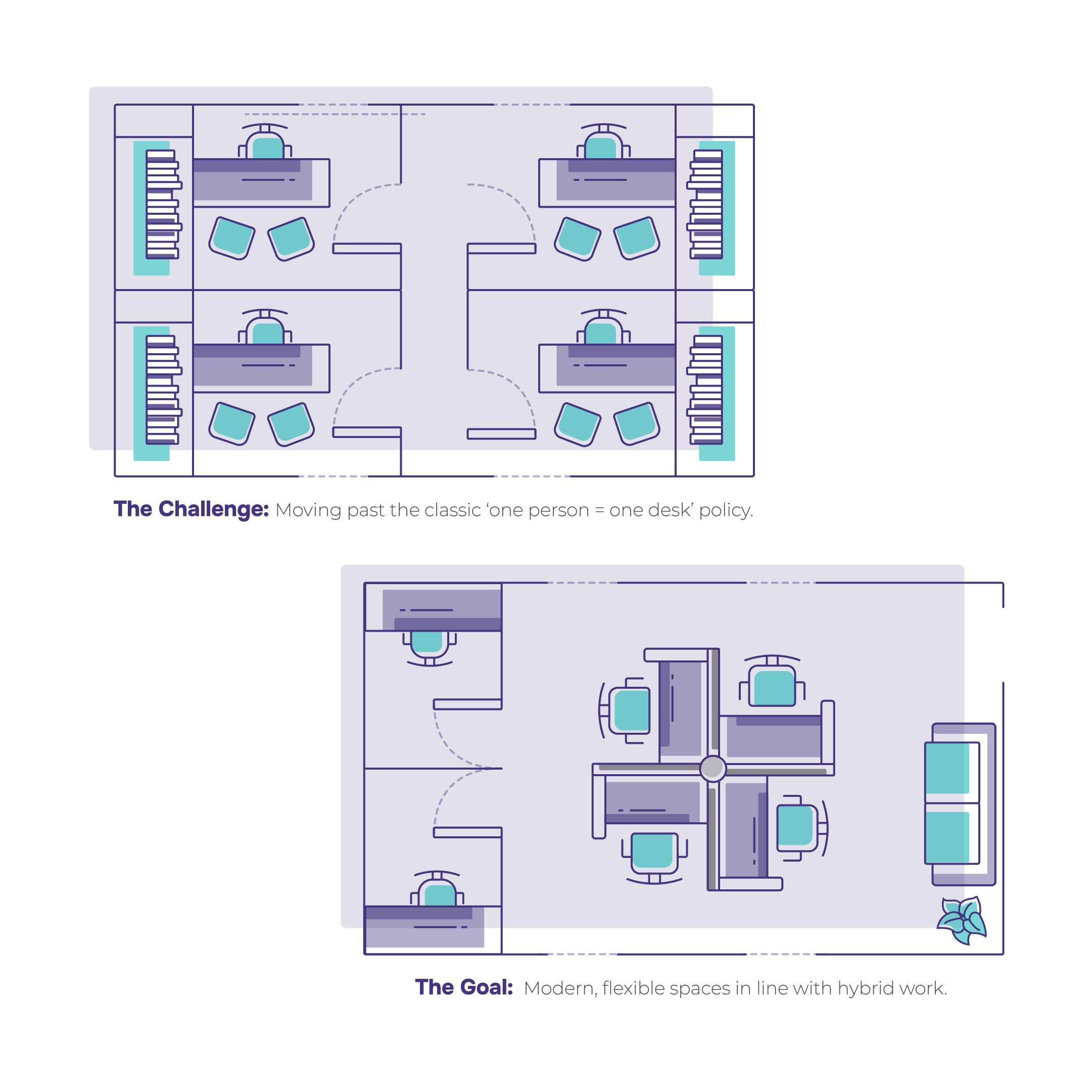
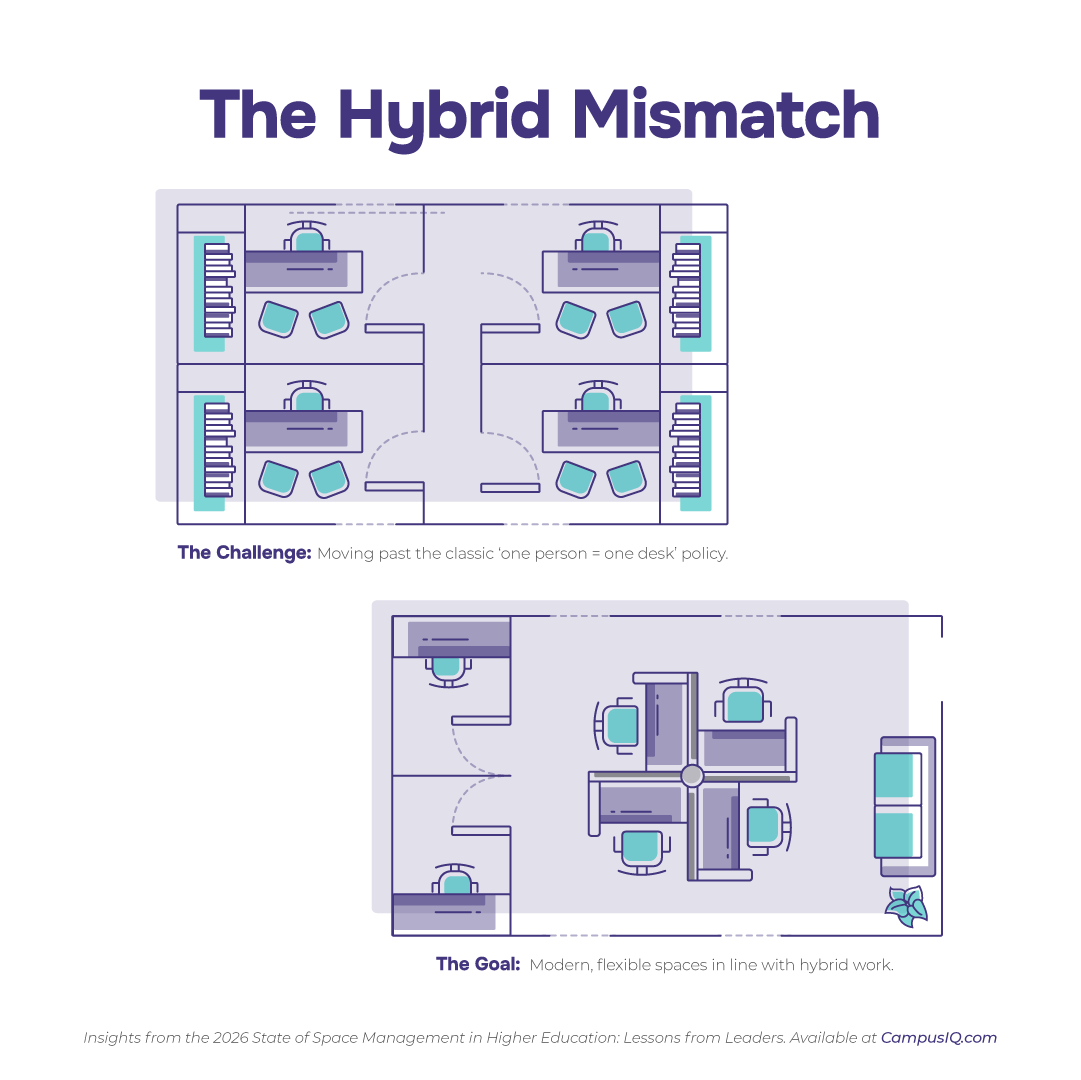
- 48% haven't updated space standards since 2021—institutions are still defaulting to the historic "one person, one desk" model even when employees are on campus only part of the week.
As Andrew Sama explained in our Bow Tie Tuesday conversation: "The story here starts with a governance gap. HR typically owns the people policy and facilities owns the space. Neither group feels comfortable launching or enforcing any kind of new space allocation standard without support from a provost or president level leader."
Without that shared mandate from the top, institutions default to what they've always done. And inertia takes hold.
Why Has HR Policy Outpaced Space Policy?
The answer comes down to risk aversion and framing.
There are real costs—political, social, and otherwise—to changing space standards on a college campus. When the conversation is framed as "taking something away" from employees, it becomes incredibly difficult to move forward.
But there's another layer to this challenge that often gets overlooked. As Alyson Goff, CampusIQ's Senior Director of Insights and Strategy, points out: "It's a reality that institutions have to prioritize financial resources, so capital investment to align outdated workspaces with modern practices is usually a lower priority. So, it's not a simple matter of putting a policy in place to realize true space savings."
In other words, updating the HR policy is straightforward. Writing a new space standard is manageable. But actually transforming hundreds of thousands of square feet of existing office space? That requires capital investment, renovation budgets, and multi-year transition plans—all competing against other institutional priorities.
But what if the conversation shifted?
"You can create more space without putting a single shovel in the ground," Andrew noted. "And without taking on additional maintenance, renewal, or operational commitments."
By being more rational about what's actually happening on campus and using occupancy data to guide decisions, institutions can unlock capacity for new programs, research centers, and faculty hires they've wanted for years.
The key is reframing the conversation from loss to opportunity—from "you're losing your office" to "you're gaining a space that works better for how you actually work."

What Updated Space Standards Actually Look Like
When institutions do update their space standards to align with hybrid work, they start by translating presence expectations into space guidelines:
- High presence (4-5 days/week): Assigned workstation, typically 100+ sq ft
- Low presence (remote most days): Touchdown space, 20-40 sq ft per person
- Middle ground (2-3 days/week): This is where institutions vary most, but it's the critical zone to address
And it's not just about desks. Effective hybrid space planning requires focus rooms, team rooms, quiet zones, and lockers—all the things people need to operate in a more flexible environment.
Andrew's advice? Start somewhere. Put something down. Be transparent about the process. And understand that it can be a living document that evolves over time.
"Do it in a small setting. See how it works. Adjust as you go," he said.
Navigating the Politics of Office Space
Office space is deeply personal. It's political. And change is hard.
So how do institutions reduce friction when trying to make a shift like this?
Use pilots as showcases. When you're piloting new office environments, make them demonstrably better. Showcase upgraded technology, better acoustics, improved collaboration rooms. Address all the things people complain about in legacy office setups. Help people understand that this is an upgrade, not a downgrade.
Build coalitions. Don't try to make change alone. Bring academic leaders, faculty, and even students into the conversation. Make change with people, not to them.
As Andrew put it: "Help them understand—what does this unlock for me programmatically that I didn't have before? Maybe I have that space to put that new research center somewhere. Maybe I have that space to hire some more faculty that I wanted to hire and couldn't before."
When you combine pilots with coalitions, you create a flywheel. The coalition makes the pilot more credible. The pilot gives the coalition something to champion. Momentum builds.
From Underutilization to Space Optimization
Right now, hybrid work exists without real space alignment. That means institutions are paying for underuse—emptier buildings that aren't as lively or pleasant as they could be.
The path forward requires:
- Transparent processes and policies that connect work patterns to space allocation
- Better data to break through the governance gap—when you can point to objective utilization metrics (like office occupancy at 30%), you can have a different conversation
- A new vision for how people want to function today—with upgraded spaces that support collaboration, focus work, and flexibility
This is about space optimization through smarter planning. It's about making the campus footprint work harder without adding more square feet. It's about using space planning software and occupancy analytics to make data-informed decisions.
Voice of the Leader
One survey respondent captured the challenge perfectly:
"Hybrid work is now embedded, but unfortunately alongside the dated 'one person, one desk' space utilization model."
— Private Research University
This is the tension institutions are living with right now. The work has changed. The space hasn't.
What's Next
The Hybrid Mismatch is just one of five critical insights from the 2026 State of Space Management Survey. The full report covers:
- The Hybrid Mismatch (what you just read)
- Beyond the Inventory: Moving from static schedules to real-time occupancy analytics
- Precision Over Growth: Treating space as a constrained asset through strategic pruning
- Data-Informed Governance: Transforming administrative bottlenecks into strategic levers
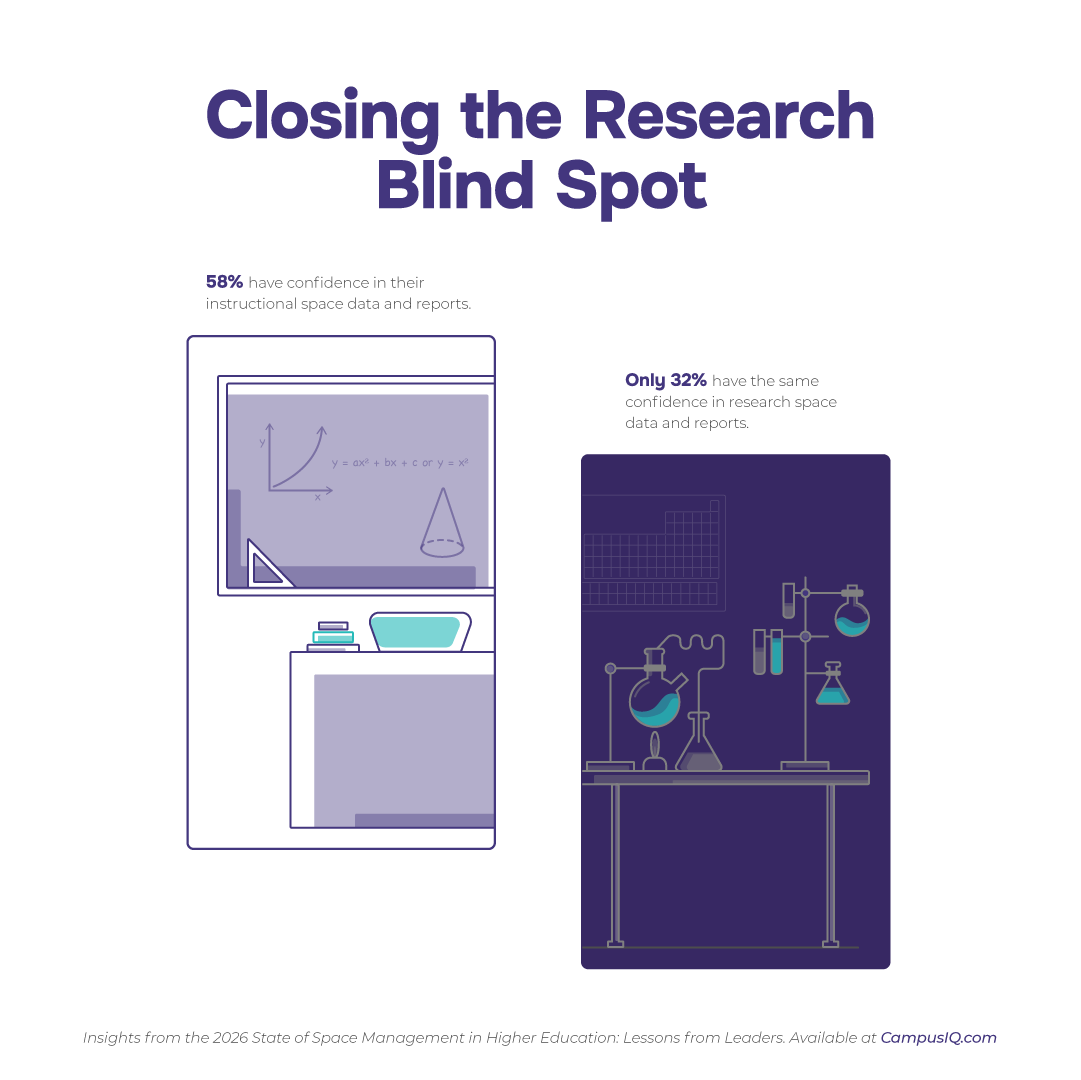
- Closing the Research Blind Spot: Bringing analytical rigor to lab environments
Each insight is backed by survey data from 31 institutions managing some of the largest, most complex space portfolios in higher education.
Download the full 2026 State of Space Management Survey Report to access all five insights, benchmark your institution's practices, and discover what leading institutions are doing to manage space more strategically.
Because if there's one thing this survey makes clear, it's that the future of higher education space management won't be defined by how much we add. It will be defined by how smartly we optimize what we already have.
Ready to close the gap between your hybrid work policies and your space standards?
Download the Full Report
The 2026 State of Space Management in Higher Education: Lessons from Leaders is a joint report by CampusIQ and Huron, based on responses from 31 institutions across North America.
Not Every Solution is Physical
Not Every Solution Is Physical: Rethinking Space Management By Alyson Goff, Senior Director of Insights & Strategy, CampusIQ