
10 min read
Flipping Campus Maintenance From 70% Reactive to Proactive
 Aaron Benz
:
September 16, 2026
Aaron Benz
:
September 16, 2026
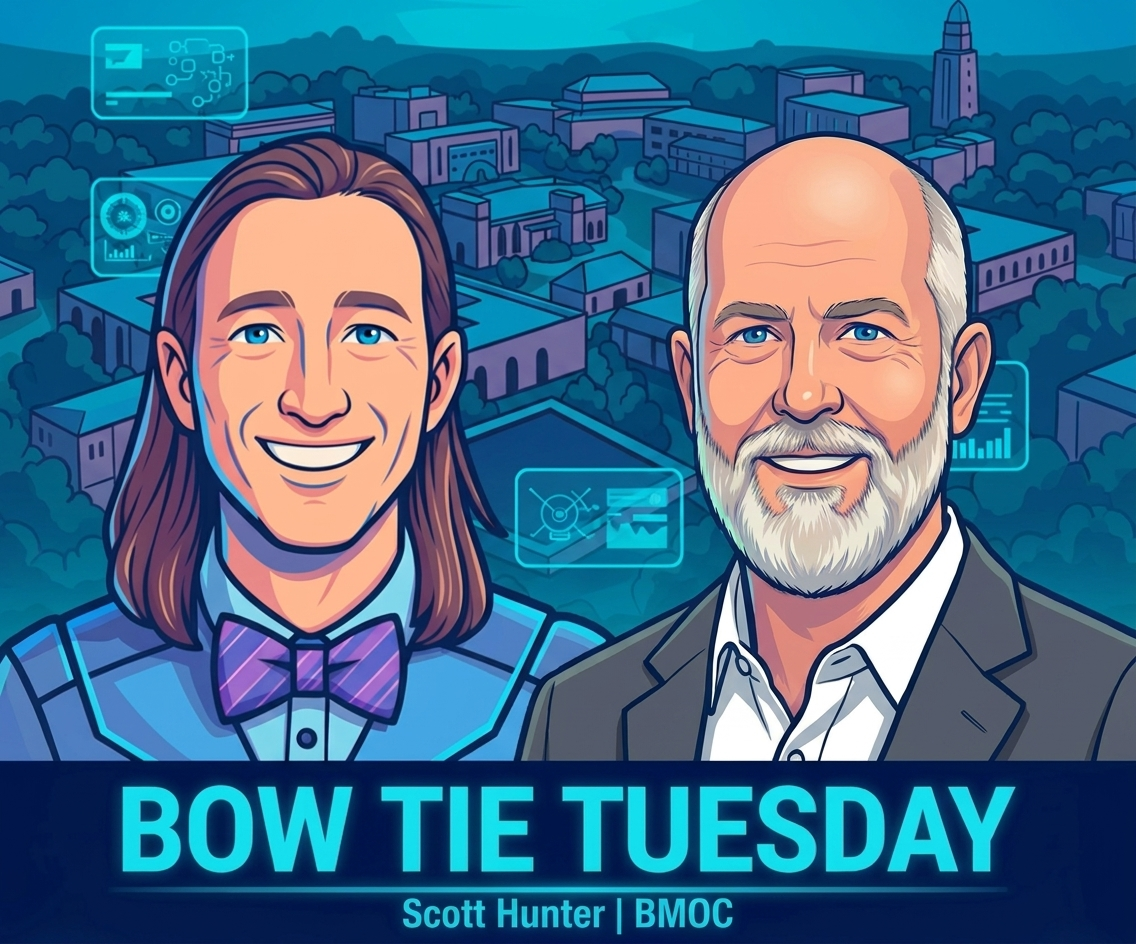
Watch the Full Conversation (15 min)
Ask a facilities team what share of their work was planned this month and the honest answer is usually a shrug. Scott Hunter, VP of Sales and Marketing at BMOC, puts the sector at roughly 30% proactive and 70% reactive, and he has spent two decades in oil and gas, mortgage inspection, and now campus buildings watching the same fix work every time. The way out is not a new platform. It is an asset record good enough to plan against, built one building at a time, so that preventive maintenance, capital renewal, and eventually predictive analysis all have something solid underneath them. In this episode he and Aaron Benz get specific about what that record contains, what it costs to skip it, and why the AI question cannot be answered before the data question is.
Key Takeaways
→ The ratio is the metric. Most institutions run near 30% proactive and 70% reactive, and almost none can state their own number on demand, which makes the problem invisible to the people funding it.
→ A nameplate is not an asset record. Knowing a unit is an air handler tells you nothing; how it was built, how many fans it actually carries, and what its real service interval is are what let you schedule around it.
→ Emergencies are the expensive path. Unplanned work costs more than the maintenance that would have prevented it, and the money has to come out of something already budgeted.
→ Buy-in comes from less work, not more. An aging workforce adopts a new program when it visibly reduces stress on them, and the data only starts flowing once they are bought in.
→ Good data has to come before the model. AI working from a thin baseline still produces confident output; Scott compares correcting it to teaching a two-year-old who insists a red object is blue.
→ Treat the facility condition assessment as living. Institutions that rebuild one every three to five years keep paying to rediscover what they already knew, while institutions that maintain it can see wear trends building before the assets fail.
Explore CampusIQ Resources
Hear more from higher education leaders working through campus challenges, from facilities and asset data to space planning and capital renewal. Watch every Bow Tie Tuesday episode and explore reports, case studies, and insights here.
Read Full Transcript
Welcome to another Bow Tie Tuesday. Today, I am pleased to be joined by Scott Hunter, VP of Sales and Marketing at BMOC. We're actually going to be diving into data. What is good data? What is bad data? What does it look like when we move from a system of compliance to a system of high fidelity? Scott, maybe we can even just start there, help frame what you guys do, the data that you guys work on, and really the goal of where we're trying to move from to move towards. Why do we even want better data?
Okay. No, that's a great place to start, Aaron. What we really do is you have to have that first interaction that brings that data to the table. But most companies, universities, and so forth are sitting right now working in reactive mode versus proactive. What we're trying to do is bring that data to the table, create it in current state, and then help customers become more proactive.
We're really looking at a 30-70 percent. Right now, 30 percent of time is spent in proactive mode. We're really, that's not helping you any because you're starting to lose on the back end. 70 percent is reactive, so you're sending your people out, try to fix this, it's an emergency, and so forth. You need to really get in. What we do is we help put those programs in place that allow you to get a proactive maintenance schedule in place, allocate your resources in the right places. Then timing-wise, yeah, you're still going to be reactive, but it takes time to put that program in place. As you said, the whole idea is to flip that. Let's become 70 percent proactive and then that reactive. Then I believe you can really get into the predictive modeling and so forth where all these different products like AI can come in and help us. Yeah, I think that's when I think about people talk about deferred maintenance or deferred capital renewal. When you get to the operation side of a university, at the end of the day, you want things to be more predictive. It's pretty crazy to think most universities, 70 percent of their maintenance is reactive, meaning, I don't even know what we're doing tomorrow. Things are going to break and I'm going to be sending people. Yeah, how do we flip that? If we're going to flip it, in some way it means we need to have better foresight into, what are the things we should be fixing before they break? 100 percent. Now, flipping them, that's a big ordeal.
How is that actually achievable? If you come into a university and let's say that's just the scenario, 70 percent of the maintenance work that they're doing is reactive, meaning it wasn't on the schedule, they had to do it ahead of time, which means now they're falling behind and they feel like they're in the spiral. Everything's always breaking. How do you go and begin to flip this equation for them where, hey, stuff's still going to break that we didn't know about, but how is most of the work actually scheduled maintenance not reactive?
Right, and that's really putting in a plan to really knowing your assets and then finding out what is the most important, what could take the most time, what's going to be most cost, right, and putting the plan there. One of the biggest things is if you ask a university, where is your biggest gap and it's usually in the resource, right? I can only put so many headcount on. Well, the best thing is making that headcount and optimizing them. So, they're using the best time, travel time, right?
So, that's windshield time to go get a part, okay? If you have an idea of what your asset is, the condition of your asset, you know how you have to perform it. You can allocate your resources to it. As you get in front of that resources, you can slim down. It may be a program of, hey, you know what? Let's look very futuristic. I'm going to have a robot deliver that part instead of having my person leave that building and go get it, all right? This future is coming to it. If you look at Uber today and in your food delivery, why not use the robots to do this, right? Those are certain things that you can put in your plan, right? And also allocate dollars that actually save you money because those resources are now being constantly working and working towards a proactive versus the reactive. Do you think, like, I can imagine there could be many reasons of why it might be challenging for universities to flip that, right? To go from 70% reactive to only 30%. And I can imagine it could be a data issue. I imagine it could be a process issue, tool issue. Like, are we just utilizing our tools well? You know, you all sit in the middle of a lot of this for helping to manage the CMMS, helping to capture data.
Like, where do you see is actually the... Where universities either underestimate or don't even realize what could be, right? Is it that they don't even realize some of their data has holes or maybe they realize that they still don't know how to get out of it or that, they're not using their tools as well as they could have to help flip that switch? Where do you see the tension? Well, I think it's in the very beginning. There's only a few universities that are really forethinking, OK?
I'm up for, I was like, Brown, MIT, Duke, University of Kentucky. They're all realizing that, hey, I really had to have a good foundation of those assets and that's identifying them and not just identifying it as, hey, this is an air handler, but getting down to really, how was it built? What is the actual preventive maintenance for that product? OK, because it may have more fans than what the OEM manual says, all right?
And then putting that program. So now you know your asset. Now you know what your life cycle is going to be on that asset and how you can extend that life. You said deferred maintenance, OK? That plays into that because you only have so much money to work from in a pool. So how do you put programs in place to extend that to where you can actually allocate dollars to other programs, right? Then it goes back into once you have the program established, is getting your workers to realize it.
We do have an aging workforce. We've got to attract new people into the industry. That aging workforce has to see that it's simpler. It's not, hey, you're making me do more. It's, hey, if you do this, it's going to cause less work and less stress on you, right? Then you have buy-in. Once you have buy-in, then you can start getting that information and then putting the different tools on top of that. AI, for example. Until you have a good baseline of good data flowing, AI is not going to return the values that you really need.
It's going to return something, but is it accurate? Right, right. Yeah, to me, we do so much internally with AI. And what I'm more convicted on than anything is, if you don't have good context to give the AI, you shouldn't expect good results. And I think it's actually pretty simple. In the same way of, if you were going to ask a human that question, how long would it take that human to go figure that out?
If the human can't go and get the data or the context of the data, how is the human supposed to give you a good answer? And so why should you expect AI to invent something that it can't itself base itself on? So I don't know if you agree with that or not, but that's kind of how I think about where some of the gaps are of what's the future promise of AI. But like, hey, what's the actual work we have to get done to set that up? 100%. So once the data is established, AI is just like a child.
It may come in a little bit smarter because it's taken in data that other people have put in there. But you really have to train it, OK? And you want to train to your specific situations. When you're looking at training, it's very similar to a two-year-old. If you sit back and watch a two-year-old learn, they're going to come to you, and they're going to pick up an object, and they may say, it's blue. Well, as your experience, it's red. It's just important to tell AI, no, it's this. Then it's going to actually store that in. Then you're starting to build a foundation of the data that you had is now building on a learning model that then can become predictive analysis in the future. But you've got to build that foundation, or you'll never get there. Yeah, it makes me think about, like, on the space inventory side, as opposed to the kind of facility asset inventory, is where policies, governance, standards come into play, where how big should you expect your office?
Well, in the same way, for an air handler, it's like, what is our policy or standard on how long we're trying to make this lifecycle go? Like, is it just to the guaranteed warranty stage, or are we actually trying to influence it to do more scheduled maintenance to try to get extra years of life on it and extend it? But if we don't know what it actually is and how long it is, and we don't have those standards, like, we can never get there, right? We can never get to really seeing farther in the future.
And there's also one other thing, is an emergency costs more than the actual maintenance. Right. So you're always planning for that maintenance. But when that emergency happens, that dollar goes out the door and you have to take it from somewhere. So that really becomes of, how do we really take care of that money? Yeah. How do you help universities think through? Because I'm sure once they get there, they feel like, my goodness, the weight I've been carrying. And when I was in all reactive mode, maybe now I'm in scheduled mode, it's kind of gone. But I think it's really hard to imagine or actually sometimes make those calls or decisions to get there when you're just in the thick of things, right? When things are breaking, you're like, look, I don't have time. I got to go scheduled because this pipe burst or this, that and the other thing. What would you say to kind of university leaders, facility leaders about how they should either position or think about the data that they have?
How can they collect better data to get to a spot where it's not going to be an overnight, things aren't going to change overnight, right? There's got to be some real work, whether it's months or whatever the time period is to get there. But how do you help encourage them to invest in their future to get out of the current state of, let's say, 70% reactive mode? It really, you've got to have that vision, you've got to build it.
And the first question is, where do you think you are today, right? It's really interesting because, of course, you have different levels within the university. You have CFOs, then you go into facility management, and then you go into the actual people that turn the wrenches. Then there's a different level and each one of them have a different idea of where they're at. And usually the guy turning the wrenches kind of really knows the conditions. But is that being captured? That's the next question. You have to evaluate the whole program from up and down. Once you understand that, hey, this is my gap, then that's where you put your first resource, right? Whether it's the money of bringing in a company to do that or having your own resources go do that and collecting that data. Once you get to a point, and it's milestones, hey, when we get to this building, and don't eat the whole university at one time, pick an area, right?
Once you do that one area, go it in phases, build it out. And as long as you're maintaining over here when your first start, by the time you get to the end, you then have a full program. So what it is is everybody thinks, oh, I'm going to start in this one building. They forget about maintaining that data that they've collected. And then by the time they get the end, they have to start over.
Those are called FCAs, and they're doing it every three to five years. Well, technically, if you're keeping that, you should have a living FCA. You should know exactly what your costs are in that building for replacement value, asset replacements. Then also know your wear and tear. So taking your company, right? You actually monitor all the traffic that's going on. You can see the trends of changing. Well, adding those trends, right? And predicting going, hey, we're getting more wear and tear in this building than we did two years ago. That means our assets are not going to last as long, OK? Where are we going to put the money from the future to replace this or keep this looking? Yeah, so getting that visibility and clarity. Even just, I don't know how many universities can strongly say, I know my reactive versus scheduled ratios, right? But maybe it's there. And then, yeah, if you think about your leaders on campus, how do they make sure they have accurate representations of what your people deployed actually in the field, actually fixing stuff? How do they actually see walking the line, so to say? How could you at least take that data to tell that story? And then I think the last thing I really heard from you was, the way you eat an elephant is one bite at a time, right? Go get quick plans that fund the future, that prove the concept, and then stack those and keep building on this.
Yeah, and you're always planning it's a one, three, five in corporations. Really, you look at university, it's one, five, ten, right? And you're doing that projected analysis for your money in that timeframe. Well, why aren't you not taking your processes and doing the same? And you can spread it over time. As you get more data and more accurate, you're able to, you'll then have more control in your five and ten years.
Awesome. Well, Scott, pleasure having you on Bow Tie Tuesday, man. Talking about data, the future, how we can get more to scheduled and predictive and get our data in line to even harness the potential of AI. Awesome. No, I appreciate Aaron having us on. It's great to work with a company like yours. Awesome. Thank you.