 Veena Vadgama
How Augusta University Reached 97% Lab Utilization | Research Space Analytics
 Veena Vadgama : Nov 11, 2025, 2:50:04 PM
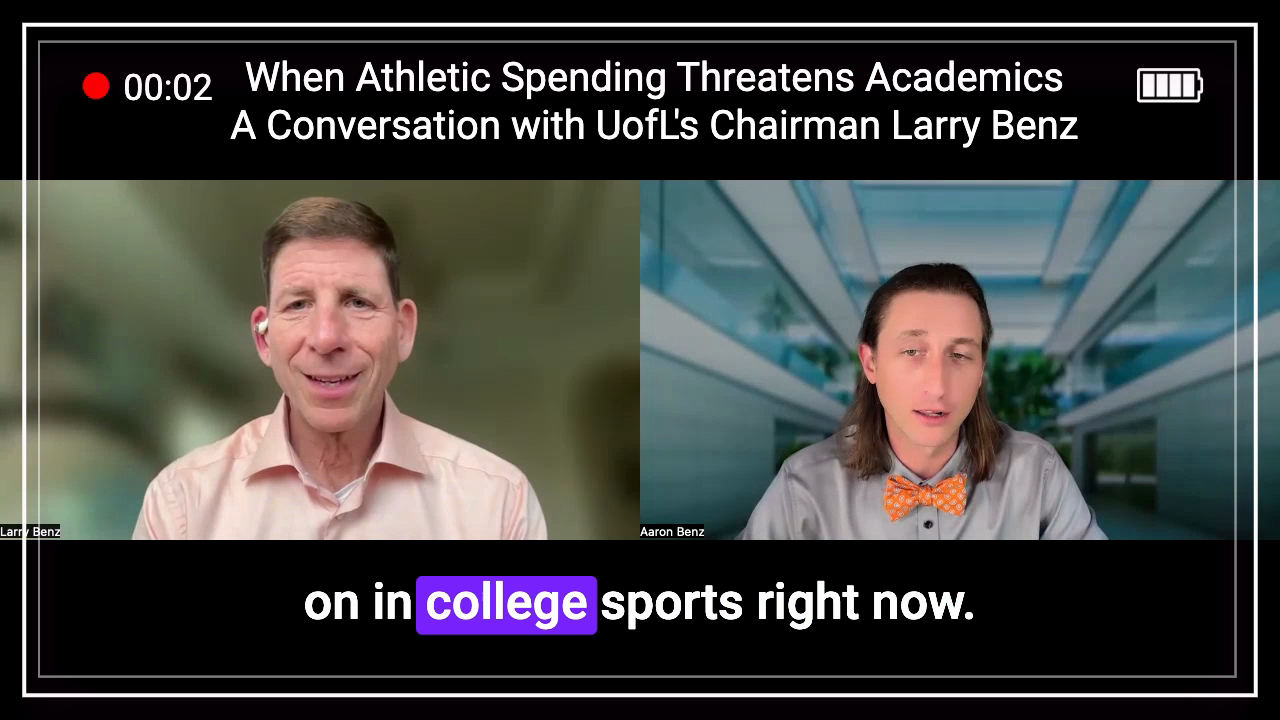
The financial sustainability of college athletics is one of the most pressing — and least discussed — challenges facing higher education leadership today. In this Bow Tie Tuesday conversation, CampusIQ CEO Aaron Benz speaks with Dr. Larry Benz, Chairman of the Board of Trustees at the University of Louisville, about why the current model of college athletics funding is structurally unsustainable and what institutions can do about it. From ballooning NIL spending to fragmented media rights negotiations, the conversation explores how athletics subsidies are pulling resources away from the academic mission — and why university leaders have a narrow window to act.
The math no longer works — Ohio State won a national championship and still lost $37 million. Penn State carries over half a billion in athletics-related debt. Louisville generates over a billion in economic impact and still runs a deficit.
NIL spending has exceeded the cap — The $20.5 million House settlement cap has ballooned to $30 to $40 million through legal workarounds — and institutions, not donors, are covering the cost.
Media rights are leaving money on the table — College football is third in viewership but ranks seventh to ninth in revenue because every conference negotiates independently. Pooling could unlock an additional $4 to $7 billion.
Athletics subsidies come at a direct cost to academics — Every additional dollar an institution spends covering athletics deficits is taken from scholarships, student success programs, and faculty resources.
Three structural reforms are needed — Pooled media rights (requiring congressional action on the Radio Broadcast Act), a hard and enforceable spending cap modeled after the NFL, and a governing body with real enforcement authority.
The runway is short — Larry Benz predicts institutions have two to three years before boards and athletic associations stop allowing general fund subsidies — forcing cuts to sports, scholarships, and competitiveness.
Louisville's Board Chairman, President, and Athletic Director published "College Athletics Is Running Out of Time" — a white paper calling for congressional action, a real governing body, and a hard spending cap. Read the coverage from WDRB.
Aaron Benz: There's something really important going on in college sports right now. It's not just athletes' pay, it's who's in charge. Ohio State won a national championship last year, still lost $37 million. Penn State's carrying more than half a billion dollars in athletics-related debt. Louisville generates over a billion annually in economic impact from athletics and still runs a deficit.
This isn't just about the winning, and it's not just about paying athletes. College sports now look and behave like a professional industry. Athletes are compensated. Coaches make millions. Media deals are worth billions, but it's still housed inside of nonprofit universities and governed like a loose association.
And that mismatch may be the real story of interest and why I'm interested in it. On Monday, University of Louisville leadership, including Trustee Larry Benz, published an op-ed arguing the current system is structurally unsustainable — that reform may require congressional action, a real governing body, and a hard spending cap.
At the same time, the SEC and Big 10 commissioned an FTI study arguing that reforms like pooling media rights nationally are, quote, "dangerously unworkable." So what's really going on here — is this a sustainability crisis, a power struggle over media rights, a free market sorting itself out, or a coordination failure that requires structural governance? And it's my privilege today to be joined by the trustee and chairman of the board at the University of Louisville, and also someone who I'm fortunate enough to call my Dad. Larry, welcome.
Larry Benz: Thank you. A pleasure to be here.
Aaron Benz: So let's get into it. You all put out a really interesting op-ed. Just help inform us of what's going on here in college athletics, and maybe why more people should care — not just in athletics, but the school, the constituents, the students, faculty, staff, the fans, and the cities and people that ultimately benefit from our institutions.
Larry Benz: Yeah. So let's unpack this a bit. You have to kind of take the pre-House settlement — which was the decision that allowed you to pay student athletes — and post. Let's just use that as a line of demarcation.
Prior to the House settlement, you had a free labor force, and so revenues that came into your athletic department for the Power Four, Power Five at that time tended to be roughly equal to your budget. In some cases, you lost a little bit. Some cases you made millions. At the University of Louisville, we used to make more money off basketball than we did football.
All that changed during the time of the House settlement, where the decision was to pay student athletes, and yet you had a defined time period between when the House settlement actually went into effect. Technically, it didn't go into effect last July, and technically right now, every college is supposed to sign a participation agreement — and that appears to be in danger, which is a rabbit hole that let's not even go down for right now.
And during that time, the reality is the college football playoff system has gotten incredibly inviting from a revenue and making money standpoint. Now, here's the reality. There are about three or four economic things that I don't think the average person who follows college athletics understands, or maybe they do at varying levels.
Point number one is that college football is the American sport. It has got an incredible following. People's desire to watch it at every level. I love watching MACtion on Tuesdays in November because I know it's gonna be on a Tuesday and there's nothing else I'd rather watch on a Tuesday than college football.
So every conference is involved in this. The conferences that have traditionally had the highest media rights have been the SEC and the Big 10. They have about 67% of all the media rights. And so the media rights have gotten quite a bit bigger — at the University of Louisville, I remember when they were insignificant.
Now they're 30, 40, 50 million at the Big 10. And the SEC, they're approaching $70 to $80 million per team per year. That's serious money. Just 10, 15 years ago that was bigger than anybody's budget. However, the House settlement basically allowed schools to spend $20.5 million in rev share. In other words, it was based on a percentage of the revenue mathematically, and that's what they came up with — $20.5 million.
The following year was $21 million, but that's not really what the cap is. The school says to the vendors, don't pay me, just do direct NIL.
Well, NIL is on top of the $20.5 million and it is unlimited. But the reality is it's coming from the school's budgets, because if you don't win in football, you're not gonna make more money from media rights. And the college football playoff system is very lucrative financially. And so football rules all of that — to the disdain or to the detriment of the average student athlete. NIL has harmed more kids than it's helped. NIL has really hurt the gender equity in the Olympic sports. They're now playing in regional areas. They're not getting to travel as much. There'll be a cut in scholarships. All of those things matter.
And so this is a complex problem that is gonna run out soon in terms of its sustainability, because the schools are not gonna be able to take general fund dollars and move it from academics to sports, nor should they. And so we have to get revenues increased by pooling and getting rid of the Radio Broadcast Act and pooling our ability.
There are estimates that we can get an additional $4 to $7 billion if we pool our media rights. So if the SEC and the Big 10 have 67% of the current media rights, the math would suggest that quite possibly they might get 67% of a larger number, and that would be a rising tide for every conference.
Put in the MAC conference, put in the HBCUs. Everybody — nobody wins unless everybody wins. All college athletes must win.
If you look at media rights, the NFL blows everybody away internationally, nationally. Second is the NBA, but third in terms of eyeballs is college football.
But eyeballs which should convert to dollars — doesn't. College ends up being seventh, eighth, or ninth. And why is that? Because every conference negotiates their own media rights. Big 10 does theirs. SEC does theirs. The ACC does theirs. The Big 12 does theirs. The MAC does theirs. If you put all those and said, we're gonna negotiate these as one — college football, 130 schools, whatever the number is — we're gonna negotiate directly.
Then you have streaming services like Amazon, Netflix, who are really in the game now. If you really take it, we're missing out on a lot of dollars on the revenue side. But that's only part of the equation. The other part of the equation is the expense. The NFL has the best NIL available. Only a few, a very small minority of NFL players get endorsements. And in college right now, tons of student athletes get endorsements and without their college jersey on, nobody even knows who they are.
And so what we have to do is go to a rational system — what I call a hard cap, meaning the $20.5 million is what the school's thought cap is. NIL is on top of that, and NIL really isn't coming from donors or vendors. In some cases it's coming some from vendors, but it's really coming from the schools. So schools are having to succumb to more and more financial losses.
So if you go to a hard cap — let's say it's $21 million — the NFL has a hard cap. That doesn't mean every school has to spend the hard cap. It just means that's what the cap is. And then if Adidas, or if Gatorade, wants to directly contract with a kid for NIL, let them. That's what the NFL does.
And we've got to stop the workarounds. It isn't cheating. These are legal workarounds. They're like the tax law. People find ways and loopholes that are not illegal, and that's what's happened in college sports. If you don't do that, the losses to the university accumulate and those losses take the form of decreased scholarships, decreased opportunities, gender equity, sports being on the way down, and less competitiveness.
Any additional dollar that a school has to pay to athletics for their losses is taken away from scholarships, student success, and other areas where it could be deployed. Now you say, well, why should we fund athletics? Well, the reason is you've got an economic boom. We've calculated — had an independent study done that showed that our economic impact at the University of Louisville is a billion and a half a year.
Now we're bearing all the cost of that, so we subsidize it through the school. And yes, fans do pay for seats. Fans do pay more and more for concessions. They absolutely do. But that doesn't withstand the $20, $30, $40 million a year in losses that you have. And so these are public institutions where you have to ask the real question: what is their purpose?
Athletics are an important part. They're the heart and soul and the window to a university. But the reality is we have to fund student success. We have to fund opportunities and scholarships and endowments for faculty and staff and things that really make a university run. And that's a real issue for universities — and the private universities just subsidize it even greater. They just don't have to release their figures and statistics publicly.
So athletics creates an economic impact that the schools are having to subsidize. That money takes away from other things. And that's the real message. The third part of solving this: you have the revenue, the media rights, and that's gonna take a legislative act of Congress to get rid of the Radio Broadcast Act.
You have a hard cap, and then a third leg of that stool is governance. You have to have a governing body that has teeth. The NCAA has primarily ruled by fear of litigation or getting sued. They're in and out of lawsuits all the time. They've been extremely ineffective in their governance style. The college sports commission equally so. You have to have a true governance platform.
So we have to put a limit on it and get to some real reform here soon. Structural reform that benefits all college athletes, not just the Big 10 and the SEC or some cherry-picked group just because they happen to be right now generating more media rights in their particular conference. We have to take a holistic view, a collaborative view that benefits everybody. Like I said, nobody wins unless all college athletes win in all conferences.
Aaron Benz: Do you think that the NCAA is positioned to do that? Or do you think it needs a different governing body? How do you get to a resolution?
Larry Benz: I think it takes a new governing board. I don't think the NCAA can effectively administer at this stage. I think the genie has been out of the bottle a little too long. Doesn't mean they don't have any role at all in college athletics. I just think to effectively govern, you're gonna have to have some board come together where it has broad representation of the conferences and of experts who can deal with this.
You look at 17, 18-year-old kids — they're not getting the NIL money or the rev share money because it's a lot more strategic. The data will tell you to get a 22 and a 23-year-old. Indiana won it with the most mature football team in the NCAA. That was a good strategy on their part. But who's at a disadvantage? A 17 and 18-year-old five-star kid.
But that allows them to say, we want to get 18% of the revenues, and that 18% becomes the hard cap, which is exactly how it's done in professional sports. What we have is college athletics being a professional sport without professional governance, without checks and balances and without boundaries. And so right now it's a runaway freight train that is only wrecking the economics of all the schools that are involved. When you have an Ohio State losing that kind of money, when you have LSU, Alabama, these schools getting $70, $80 million in media rights, losing millions of dollars a year. Penn State, most overleveraged group next to maybe Florida State — these are serious dollars at public universities.
I think if nothing changes, I predicted last year there'd be about a two to three year runway, meaning that's the last time boards, athletic associations are gonna allow their schools to subsidize their athletic departments that much through student fees, through general funds, and otherwise. And most are already saying no.
So the athletic departments are just simply borrowing more money. And when that happens, they'll have to spend less, which makes them less competitive. And at the same time, cut sports and have an athletic department that is much more accountable relative to its profit and loss. And if that happens — less spending, less scholarships, less competitiveness, all the things that would go with it.
I think that's got about another season or two left in it. And then the last piece again is this hard cap on the spending. So governance has to happen and this can happen over the next two to three years, if brighter minds prevail.
Aaron Benz: Very cool. Thank you so much. Enjoyed this Bow Tie Tuesday.
Larry Benz: Absolutely.