
 Veena Vadgama
The Hybrid Mismatch: Why Flexible Work Policies Are Racing Ahead of Space Standards
 Veena Vadgama : Jan 28, 2026, 10:34:30 AM
by Veena Vadgama, CMO at CampusIQ
By Veena Vadgama, CMO, CampusIQ
When CampusIQ partnered with Huron to launch the 2026 State of Space Management Survey, we had a hypothesis: higher education's relationship with physical space was changing in fundamental ways. What we didn't fully anticipate was just how quickly—and how deliberately—that change is happening.
The results are in, and they tell a story that every facilities leader, provost, and campus planner needs to hear.
We surveyed 31 universities across North America—institutions managing millions of square feet, operating multiple campuses, and navigating some of the most complex space portfolios in the sector. What emerged were five critical insights that are redefining how universities plan, allocate, and optimize their physical footprint.
This week, our CEO Aaron Benz sat down with Andrew Sama, Higher Education Director at Huron, to unpack one of the most striking findings: universities are no longer defaulting to growth. They're choosing precision.
For decades, institutional success was measured, in part, by square footage. A new building signaled momentum. A larger campus meant prestige. But that narrative is shifting.
Since 2021, 68% of surveyed institutions have strategically exited at least one lease. Another 52% have made deliberate decisions not to build or lease space that was previously under consideration. And perhaps most notably, 48% have demolished at least one building.
These aren't emergency cuts. They're strategic decisions backed by data.
As Andrew Sama put it in our Bow Tie Tuesday conversation: "Demolishing a building is really complex. It has to be a very intentional action. There's capital planning involved, feasibility analysis, stakeholder engagement. You really have to be willing to retire that asset permanently."
And yet, nearly half of the institutions in our survey have done exactly that. This graphic below provides the full results from our respondents.
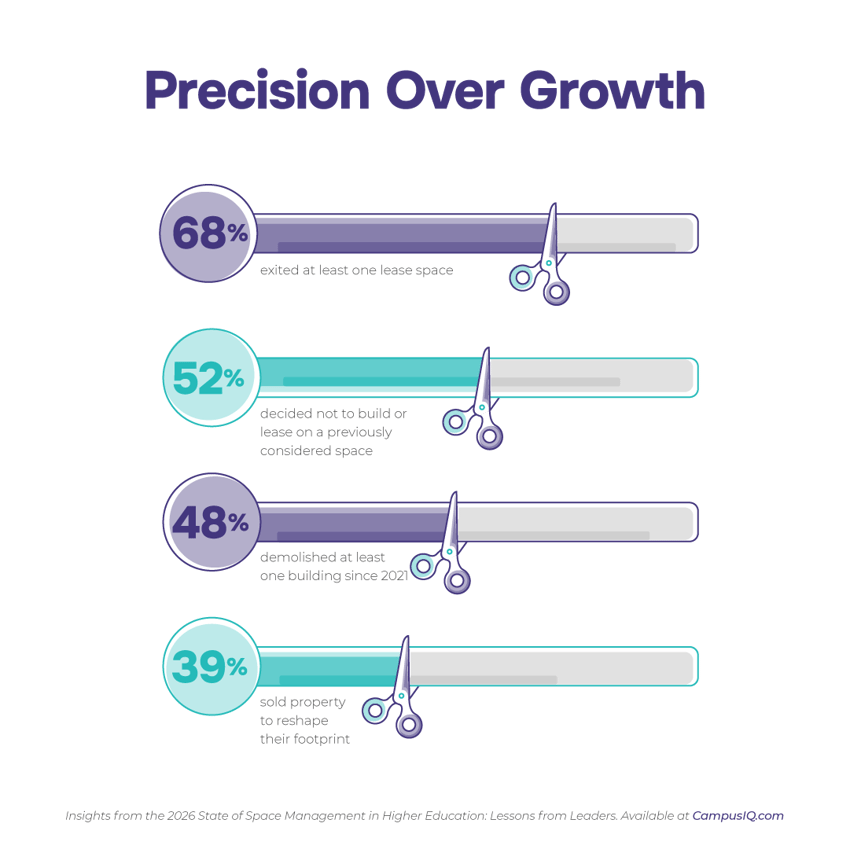
The numbers tell the story. Deferred maintenance backlogs continue to grow. Stewardship costs are rising disproportionately compared to other expenses. One respondent captured the stakes clearly:
"Space is expensive. The value of our facilities' GSF far exceeds our endowment and is central to the strength of our brand. Stewardship costs are rising disproportionately compared to all other expenses. Effective utilization of every square foot is essential to academic success."
— Public Research University
Universities are reaching a point where they can't invest their way out of the problem. The traditional playbook—add more space, expand the footprint—no longer works when operating budgets are strained and every square foot carries a long-term financial commitment.
The institutions pulling ahead are those treating space as a constrained, high-stakes asset rather than an unquestioned marker of prestige.
If you're a facilities leader looking at your portfolio and thinking, "We need to do this too, but where do we begin?"—Andrew Sama offered a clear roadmap in his conversation with Aaron.
It starts with three critical data points:
Understand the health of your assets through facility condition assessments. Where is the risk in your portfolio? Which buildings are deteriorating fastest?
Get to a dollar-per-square-foot figure on what it actually costs to maintain your space—custodial, utilities, operations, security. Not estimates. Real, comprehensive cost data.
Move beyond anecdotes and get to verifiable occupancy data. This is where space analytics becomes essential. What's really being used? What's underutilized? What's overutilized?
When you cross-tab those three data points—condition, cost, and utilization—you get a grounded picture of what's working, what's not, and where the opportunities are.
One of the most insightful parts of the conversation was Andrew's advice on how to get campus leaders comfortable with reducing the footprint when growth pressure still exists.
His recommendation? Start with pilots.
Do something small—adjust space allocation on a single floor in a single building. Create a proof of concept. Let people see and react to something tangible instead of debating hypotheticals.
And then build a coalition. Don't try to make change alone. Involve academic leaders, faculty, even students where appropriate. Make change with people, not to them.
If you do both—use pilots and build coalitions—it creates a flywheel. The coalition makes the pilot more credible. The pilot gives the coalition something to champion. Momentum builds.
Here's what's important to understand: this trend isn't about making campuses smaller or less meaningful. It's about making them better. It's about ensuring that every building is full, lively, and advancing the mission. It's about not paying for space that isn't adding value to the student, staff, or faculty experience.
As Aaron put it: "The emphasis here really isn't on retrenchment. It's on stewardship. How do we focus on making a better campus where our buildings are full and they're lively, and we're not paying for buildings that aren't adding value?"
Growth isn't gone. It's just intentional now. Strategic. Backed by space analytics and occupancy data.
The 2026 State of Space Management Report includes four additional insights beyond Precision Over Growth—covering hybrid workspace alignment, real-time occupancy analytics, data-informed governance, and closing the research facility blind spot.
Each insight is backed by survey data from 31 universities and includes benchmarks you can use to evaluate your own strategy.
Download the full report to access all five insights, or watch the complete Bow Tie Tuesday conversation between Aaron and Andrew.
Because if there's one thing this report makes clear, it's that the future of higher education space management won't be defined by how much we add. It'll be defined by how smartly we steward what we already have.
Veena Vadgama is Chief Marketing Officer at CampusIQ, a space analytics platform purpose-built for higher education.
Veena Vadgama : Jan 28, 2026, 10:34:30 AM
by Veena Vadgama, CMO at CampusIQ

Veena Vadgama : Feb 4, 2026, 1:16:14 PM
When CampusIQ and Huron surveyed 31 universities across North America for the 2026 State of Space Management in Higher Education report, one finding...
Veena Vadgama : Jan 20, 2026, 3:28:50 AM
NEWS